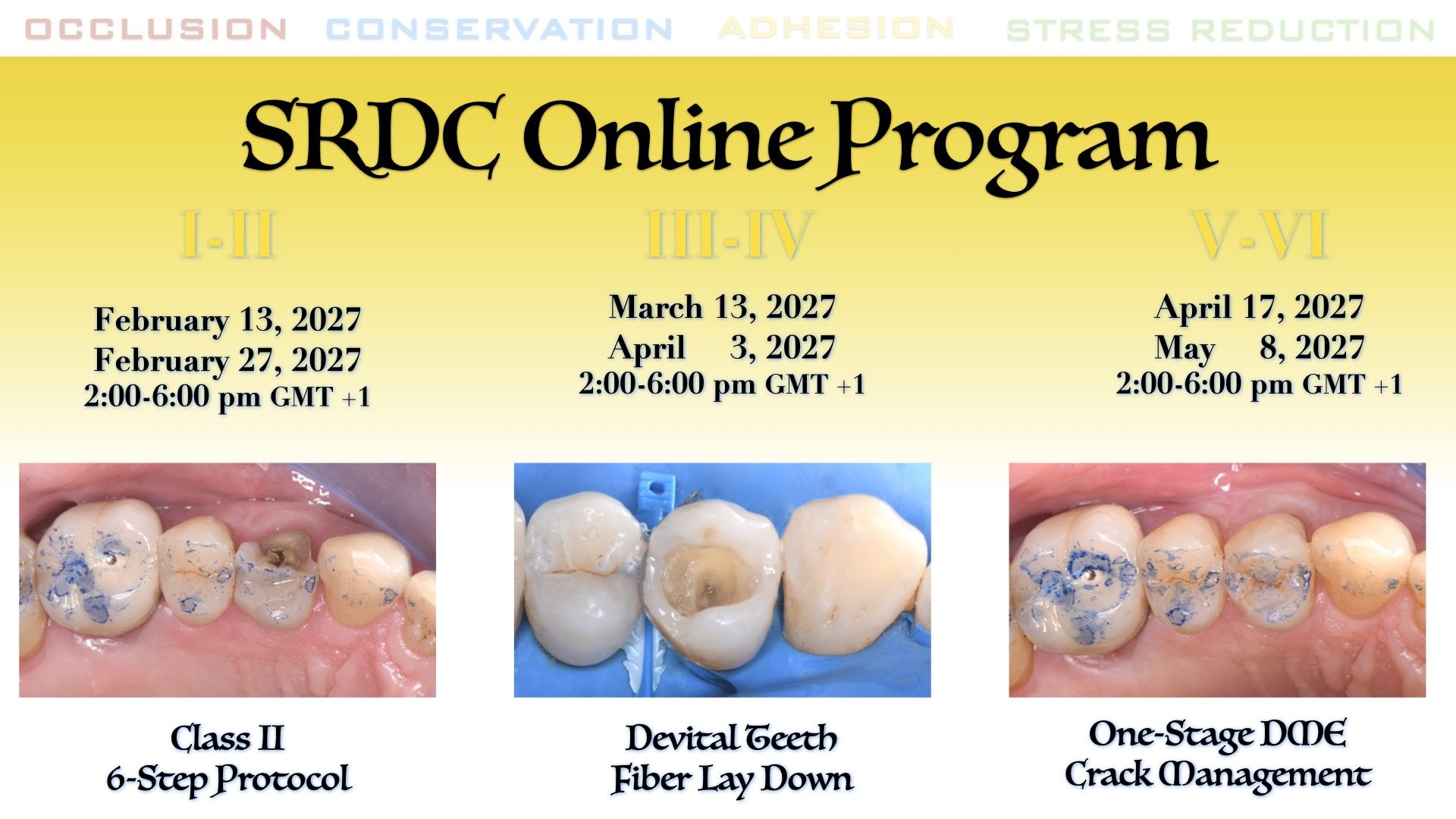
Fundamentals of stress reduced direct composite (SRDC) restorations in the posterior area
February 13, 27 | March 13 | April 3, 17 | May 8 2027 (2:00 - 6:00 pm GMT +1)
6 modules
Duration: 4-hour lecture each module for a total of 24-hour training
Scheduled Time: 2pm-6pm CET
Format: Each Module includes 2 hours of literature review and 2 hours of clinical case presentation
Module I: Stress Management and Bonding
The stress coming from occlusal loading: the role of enamel, dentin and DEC (Dentin Enamel Complex) to counteract stress
Introduction to SRDC restorations: the origin of contraction stress and the clinical protocols to reduce stress in composite resins
C-Factor, Layering and Curing protocols, Composite Resin Formulation
Adhesion to enamel and dentin (superficial and deep dentin, sclerotic and cracked dentin, caries affected dentin)
IDS (Immediate Dentin Sealing) vs Resin Coating (RC) vs SRDC protocols
How a SRDC protocol improves the physical and mechanical properties of composite resins
Clinical case presentation: Class I and Class II restorations
Module II: The 6-step clinical protocol
1- Pre-op evaluation of occlusion and tooth morphology; direct and indirect mock-ups
2- Enamel Preservation (no cusp shoeing) and Dentin Preservation (bonding to caries affected dentin to save tooth vitality)
3- Structural Analysis of tooth cavity reviewed
4- Adhesion protocols for 3-step etch & rinse, 2-step self etch and Universal Adhesive Systems in SRDC restorations: how to maintain the seal over the years
5- Layering and Curing Protocols: separately restoring enamel and dentin to reduce stress
6- Occlusal force equilibration
Clinical case presentation: Direct Coverage of fractured Cusps and Verticalizing the occlusion
Module III: The Wall-papering Protocol
Entering the “no crown, no prep, no post” era
Continuous Fibers vs Short Fiber Reinforced Composites
Wall-papering Protocol Vs Post & core Build-ups
Lay Down Protocols for Continuous Fibers for structurally compromised teeth:
reinforcement effect
improving the sealing
reducing the stress
increasing damage tolerance
The safe-fail mechanism concept
Clinical case presentation: Wall-papering for vital and devital teeth
Module IV: Preservation over Preparation Concept for Structurally Compromised Teeth
Tooth Fragment Reattachment
No cusp shoeing for vital and devital teeth: how to make extra thin cavity walls working
Management of dentin cracks on vital and devital teeth: chasing vs bridging cracks
Dentin Crack Bridging for SRDC restorations
DME (Deep Margin Elevation) armamentarium and protocols
Occlusal Table Design and Verticalizing the Occlusion
Clinical case presentation: Crack Bridging, Tooth fragment reattachment and Extra Thin Wall Conservation
Module V: Restoration of Highly Structurally Compromised Teeth
The Bio Base Design (BBD) for the restoration of devital teeth: the direct approach
The restoration of teeth with one wall remaining: the external and internal ferrule concept
The sub occlusal fiber lay down protocol for Continuous Fiber Supported SRDC restorations (CFS-SRDC)
The Bio Base Design (BBD) for the semi-direct and indirect techniques
DME vs Crown Lengthening
Clinical case presentation: Advanced Fiber Lay Down Protocols for Structurally Compromised Devital Teeth
Module VI: Longevity of SRDC restorations
Overlays via CFS- SRDC restorations
Full mouth rehabilitation via SRDC restorations
Long term Clinical Performance of SRDC restorations on vital and devital teeth
Clinical case presentation: Full mouth rehabilitation and Long-term Follow-ups