
Fundamentals of stress reduced direct composite (SRDC) restorations in the posterior area
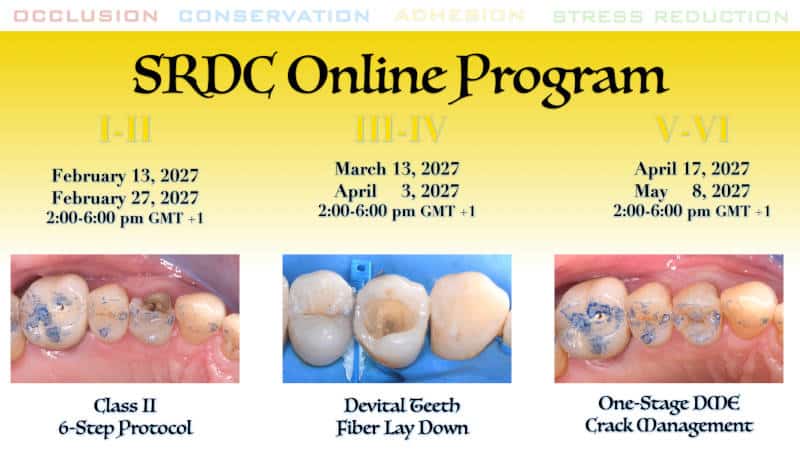
SRDC Online Course:
6 modules
Duration: 4-hour lecture each module for a total of 24-hour training
Scheduled Time: 2pm-6pm CET
Format: Each Module includes 2 hours of literature review and 2 hours of clinical case presentation
Module I: Stress Management and Bonding
The stress coming from occlusal loading: the role of enamel, dentin and DEC (Dentin Enamel Complex) to counteract stress
Introduction to SRDC restorations: the origin of contraction stress and the clinical protocols to reduce stress in composite resins
C-Factor, Layering and Curing protocols, Composite Resin Formulation
Adhesion to enamel and dentin (superficial and deep dentin, sclerotic and cracked dentin, caries affected dentin)
IDS (Immediate Dentin Sealing) vs Resin Coating (RC) vs SRDC protocols
How a SRDC protocol improves the physical and mechanical properties of composite resins
Clinical case presentation: Class I and Class II restorations
Module II: The 6-step clinical protocol
1- Pre-op evaluation of occlusion and tooth morphology; direct and indirect mock-ups
2- Enamel Preservation (no cusp shoeing) and Dentin Preservation (bonding to caries affected dentin to save tooth vitality)
3- Structural Analysis of tooth cavity reviewed
4- Adhesion protocols for 3-step etch & rinse, 2-step self etch and Universal Adhesive Systems in SRDC restorations: how to maintain the seal over the years
5- Layering and Curing Protocols: separately restoring enamel and dentin to reduce stress
6- Occlusal force equilibration
Clinical case presentation: Direct Coverage of fractured Cusps and Verticalizing the occlusion
Module III: The Wall-papering Protocol
Entering the “no crown, no prep, no post” era
Continuous Fibers vs Short Fiber Reinforced Composites
Wall-papering Protocol Vs Post & core Build-ups
Lay Down Protocols for Continuous Fibers for structurally compromised teeth:
reinforcement effect
improving the sealing
reducing the stress
increasing damage tolerance
The safe-fail mechanism concept
Clinical case presentation: Wall-papering for vital and devital teeth
Module IV: Preservation over Preparation Concept for Structurally Compromised Teeth
Tooth Fragment Reattachment
No cusp shoeing for vital and devital teeth: how to make extra thin cavity walls working
Management of dentin cracks on vital and devital teeth: chasing vs bridging cracks
Dentin Crack Bridging for SRDC restorations
DME (Deep Margin Elevation) armamentarium and protocols
Occlusal Table Design and Verticalizing the Occlusion
Clinical case presentation: Crack Bridging, Tooth fragment reattachment and Extra Thin Wall Conservation
Module V: Restoration of Highly Structurally Compromised Teeth
The Bio Base Design (BBD) for the restoration of devital teeth: the direct approach
The restoration of teeth with one wall remaining: the external and internal ferrule concept
The sub occlusal fiber lay down protocol for Continuous Fiber Supported SRDC restorations (CFS-SRDC)
The Bio Base Design (BBD) for the semi-direct and indirect techniques
DME vs Crown Lengthening
Clinical case presentation: Advanced Fiber Lay Down Protocols for Structurally Compromised Devital Teeth
Module VI: Longevity of SRDC restorations
Overlays via CFS- SRDC restorations
Full mouth rehabilitation via SRDC restorations
Long term Clinical Performance of SRDC restorations on vital and devital teeth
Clinical case presentation: Full mouth rehabilitation and Long-term Follow-ups
Fundamentals of stress reduced direct composite (SRDC) restorations in the posterior area
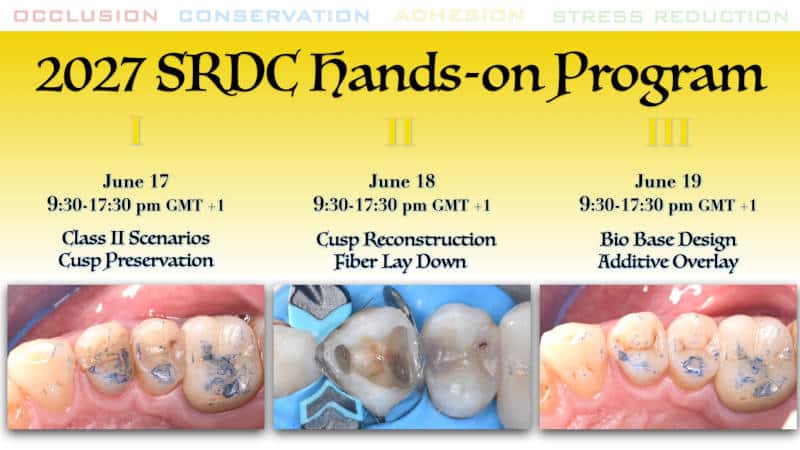
Hands-on Training & Live Patient Demo
SIMONE DELIPERI, D.D.S., Adjunct Assistant Professor, Prosthodontics and Operative Dentistry, Tufts University School of Dental Medicine.
Following the 6-day online training, the 3-day hands-on course and live patient demo aims to practice the SRDC protocol you learnt online.
Only those who attended the online course are eligible to participate to the live sessions. The goal is to provide the highest teaching quality for doctors who got the same scientific background.
The live sessions cover both the stress-reduced direct composite (SRDC) and the wall-papering protocol to predictably restore posterior teeth using an additive no invasive approach.
The live sessions give attendees the unique opportunity to practice the four fundamentals of a SRDC protocol: 1. Occlusion, 2. Conservation, 3. Adhesion, 4. Stress Reduction
DAY I Thursday, May 22 9.30-16:30
Live Patient Demo (morning)
Exercise to be completed in the hands-on session
1- Pre-op functional mock-up
2- Adhesion protocols for SRDC restorations: 3-step etch& rinse, 2-step self etch and Universal Adhesive Systems
3- MO Class II on a second premolar
4- MOD Class II on a first molar tooth
5- Continuous Fiber Management: size and length selection, wetting & folding protocols
6- Wall-papering of a large class I cavity on a molar tooth
Welcome pizza dinner 20:00
DAY II Friday, May 23 9.30-16:30
Exercise to be completed in the hands-on session
1- Adjacent Class II restorations MO (first molar tooth) – DO (second premolar)
2- MO Class II Direct Cusp Replacing Restoration with a missing MB cusp
3- MOD Class II Direct Cusp Replacing Restoration with two missing cusps
4- Wall-papering of a class II cavity on a premolar and molar tooth
5- How to verticalizing the occlusion
DAY III Saturday, May 24 9.30-16:30
Exercise to be completed in the hands-on session
1- The Bio Base Design (BBD) for the restoration of devital teeth: the direct approach
2- Cusp reattachment of fractured teeth
3- “The remaining single wall” tooth restoration
4- The Direct Overlay
5- The BBD (bio base design) for semidirect restoration of devital teeth
Graduation Dinner 20:00
Learning objectives:
1- Understand a stress-reducing technique: occlusion management , conservation strategies, maturation of the bond, layering and curing protocols
2- Comparing a stress-reduced direct technique with traditional techniques available for the restoration of posterior teeth
3- Become familiar with the stress-reducing direct composite (SRDC) technique through a step-by-step clinical protocol
4- Learn a fiber lay down protocol to mimic the functional characteristic of the natural dentition
Topics covered through demonstration and hands-on experience:
Occlusal loading strategies for SRDC restorations: clinical scenarios, direct and indirect pre-op mock-up
Bonding protocols for 3-step etch & rinse, 2-step self-etch and universal adhesive systems
Matrix, ring and wedge selection for adequate anatomical contact
Composite layering technique for Class II restorations
Polyethylene fibers vs e-glass fibers vs SFRC (Short Fiber Reinforced Composite)
Light curing sequences
MO/DO, MOD, direct cusp coverage restorations on both vital and devital teeth
Fiber lay down strategies
Materials provided by the SDTC for the Hands-On course to be returned after the course:
- Type’ odont
- Curing Light
- High speed handpiece and burs
- Composite instruments and perio probe
- Sectional and circular matrix systems
- Restorative materials: adhesive system, composite, continuous fibers
Materials NOT provided for the Hands-On course
Extracted Natural Teeth
Loupes
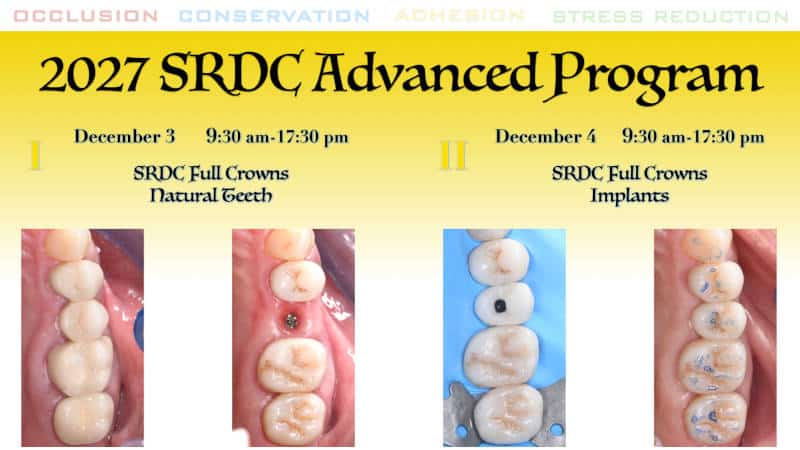
Advanced SRDC Restorations
Day I and II: lecture and hands-on course
Duration: 8 hours a day for a total of 16-hour training
Scheduled Time: 9:30 am – 17:30 pm CET
Format: Each Day includes 2 hours of lecture and 6 hours of clinical case presentation
PFM/ Zirconia Crown replacement with SRDC Crowns
Rubber dam Isolation techniques
Selection of Matrix Systems: sectional vs circular
Silicone Index
DME
Creating anatomical proximal contact points
Fiber Lay Down Protocols
Shade selection and layering
Occlusal Table Design and Verticalizing the Occlusion
Clinical case presentation: Reconstruction of abutment teeth with SRDC Restorations on both vital and devital teeth
Composite Resin Crowns on Implants: the Direct Approach
Composite vs Zirconia
Screwed vs cemented crowns
Bonding to titanium and Masking the titanium abutments
The temporary crown fabrication
Copying and Pasting the emergence profile
Creating proximal contact points
Shade selection and layering
Occlusal Table Design and Verticalizing the Occlusion
Clinical case presentation: Reconstruction of Composite Resin Crowns bonded to Titanium Abutments
Materials provided by the SDTC for the Hands-On course to be returned after the course:
- Type’ odont
- Curing Light
- High speed handpiece and burs
- Composite instruments and perio probe
- Sectional and circular matrix systems
- Restorative materials: adhesive system, composite, continuous fibers
- Implant abutment, implant analogue, screw drivers
Materials NOT provided for the Hands-On course
Extracted Natural Teeth
Loupes
Additive Direct Composite Restorations (ADCR) in the Anterior Area
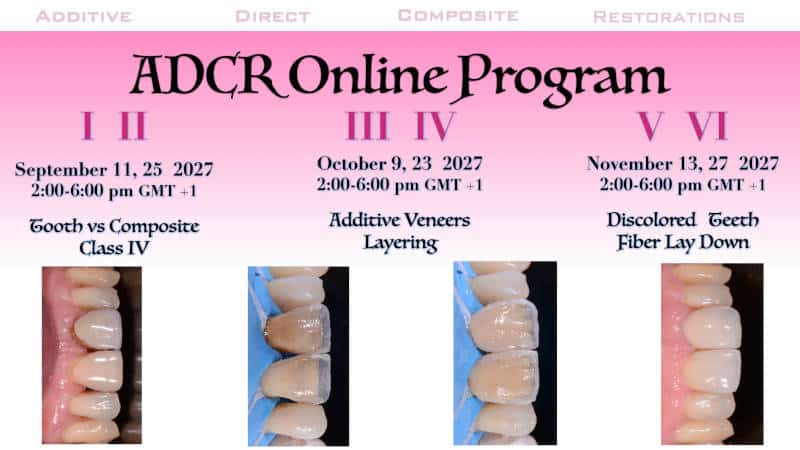
ADCR Online Course:
6 modules
Duration: 4-hour lecture each module for a total of 24-hour training
Scheduled Time: 2pm-6pm CET
Format: Each Module includes 2 hours of literature review and 2 hours of clinical case presentation
Day I: Tooth vs Composite resin
Anatomy of tooth in the young, adult and elderly patient
Understanding composite materials: body, dentin, translucent and enamel shades
Layering strategies to mimic the cervical, middle and incisal third of the tooth
Tooth form: Direct Mock up and silicone index fabrication
Shade Matching: value, transulency and chroma
Tooth whitening on vital teeth
3D Layering for Class III and Class IV cavities
How to avoid aesthetic failures
Clinical case presentation: Class III and Class IV restorations
Day II: Class IV restorations
Microhybrid vs Nanohybrid vs Nanofilled composite: optical properties and polish ability
Macro Twin Flashes and Cross-polarized illumination
Bonding protocols: 3-step etch & rinse vs 2-step self etch vs Universal Adhesive Systems
Class IV Layering: natural layering vs polychromatic layering vs multi laminar layering
Strategies to mask the fracture line in a Class III and Class IV cavity
Fiber lay down in Class IV cavities
Clinical case presentation: Advanced Class IV restorations
Day III: Diastema Closure
Pre-op mock up: evaluation of tooth form and function
Direct composite vs porcelain veneers
Isolation protocols for diastema closure: retraction cords and rubber dam selection
Matrixing and wedging
Emergence profile, contact points and gingival papilla
Treatment of localized dental erosion in the anterior area: ADCR and The Dahl principle
Finishing and Polishing techniques: gloss and luster with composite resins
Clinical case presentation: Rubber dam isolation and layering technique for
diastema closure
Day IV: Additive Direct Composite Veneers and Crowns on vital teeth
Indirect mock-up: silicon index fabrication from the lab
Occlusion evaluation and parafunction habits
Material selection: composite vs porcelain
Tissue management and rubber dam isolation for the cervical area
Layering protocols for additive composite veneers on vital teeth
Post orthodontic additive veneers
Shape modification for the misaligned dentition
Clinical case presentation: Direct composite veneers and full crown reconstruction on vital teeth
Day V: Additive Direct Composite Veneers on devital teeth and Fiber lay down protocols
Tooth whitening protocols for devital teeth
Advanced layering protocols for teeth resistant to bleaching
Combined endodontic access and class IV-Class III restorations
Preservation of ultra thin remaining cavity walls
Fiber lay down protocols for structurally compromised teeth
Masking strategies for the discolored dentition
Mimicking the shade of adjacent teeth via layering
Line angles and texture design
Clinical case presentation: Direct composite veneers on discolored teeth and fiber lay down strategies
Day VI: Class V lesions, The full crown layering and The Full Mouth Rehab
The perio-restorative approach to class V lesions and gingival recession: a combined restorative and surgical approach
Layering of discolored abutment teeth: the full crown reconstruction
The Full mouth rehabilitation via SRDC and ADCR protocols
The combined ADCR and Porcelain restoration approach
Clinical case presentation: Treatment of Class V lesions, Full crown reconstruction and Full mouth rehabilitation
Additive Direct Composite Restorations (ADCR) in the Anterior Area
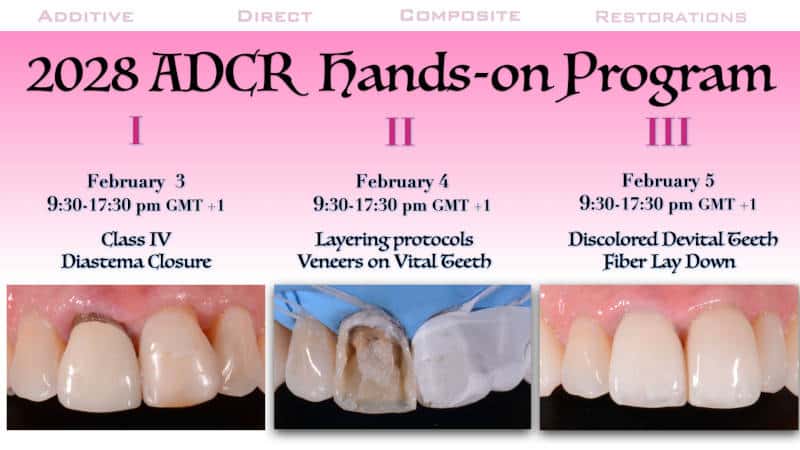
2028 Hands-on Training & Live Patient Demo
SIMONE DELIPERI, D.D.S., Adjunct Assistant Professor, Prosthodontics and Operative Dentistry, Tufts University School of Dental Medicine.
Following the 6-day online training, the 3-day hands-on course and live patient demo aims to practice what you learnt online.
Only those who attended the online course are eligible to participate to the live sessions. The goal is to provide the highest teaching quality for doctors who got the same scientific background.
This program is designed for dentists wishing to achieve excellence with direct anterior composite restorations.
The hands-on course will cover an additive approach for the restoration of both vital and devital teeth in the anterior area. A step-by-step protocol will guide clinicians to “go additive” in most direct anterior applications! Participants will learn how to mimic both the mamelon expression, the incisal characterization and the incisal halo.
Particular attention will be given to the non invasive restoration of discolored and structurally compromised teeth as well as teeth resistant to bleaching procedure. A fiber lay down protocol will be presented to increase the fracture toughness of these teeth.
Completion of the course should provide attendees with many tips and tricks they may apply the next Monday in their practice.
DAY I Thursday, February 3 9.30-17:30
Live Patient Demo (morning)
Exercise to be completed in the hands-on session
1- Pre-op functional mock-up and fabrication of silicone index
2- The 3D meticulous management of the body, dentin, trans and enamel shades to achieve both color integration and vitality
3- Class IV for the young, adult and mature dentition
4- Diastema closure and black triangles closure
How to get good anatomy and avoid aesthetic failures
DAY II Friday, February 4 9.30-17:30
Exercise to be completed in the hands-on session
1- Additive Veneers from right first premolar to left first premolar
2- Fiber lay down protocols for structurally compromised anterior teeth
3- Combined endodontic access and class IV-Class III restorations
4- Combined endodontic access, class IV cavities and Diastema Closure
DAY III Saturday, February 5 9.30-17:30
Exercise to be completed in the hands-on session
1- The restoration of discolored anterior teeth using an additive approach
2- The ADCR full crown restoration
3- Combined fiber lay down and semidirect protocols for the full crown restoration
Learning Objectives:
- Understand plus and minus of different composite systems
- Learning specific layering protocols for different composite brand to restore vital and devital anterior teeth
- Compare a direct technique with traditional techniques available for the restoration of anterior teeth (porcelain laminate veneers, zirconia crowns)
- Understand how to replicate the esthetic appearance of porcelain restorations with a step-by step protocol for direct restorations
- Become familiar with a new technique for the restoration of discolored teeth resistant to bleaching
- Learn a fiber lay down protocol to mimic the functional characteristics of the natural dentition when teeth are structurally compromised
Topics covered through demonstration and hands-on experience:
- Silicone Matrix Fabrication
- Criteria for composite choice: single mass vs dual vs polychromatic technique
– Selection of a bonding agents (etch & rinse vs self-etch)
– Matrix, wedge selection and adequate anatomical contact creation
- Composite layering technique for ADCR: Additive Class IV, Veneers and full coronal layering on both vital and devital teeth
– Fiber lay down strategies
– Finishing and polishing: how to reproduce the macro and micro-texture of the natural teeth
Materials provided by the SDTC for the Hands-On course to be returned after the course:
- Type’ odont
- Curing Light
- High speed handpiece and burs
- Composite instruments and perio probe
- Sectional and circular matrix systems
- Restorative materials: adhesive system, composite, continuous fibers
Materials NOT provided for the Hands-On course
Extracted Natural Teeth
Loupes

Testimonials
Dr. Deliperi’s SRDC course is foundational to my pursuit of mastering biomimetic dentistry. I can’t help but practice dentistry differently now to the benefit of my patients and my own sense of doing my best work.
Dr. Deliperi is an expert in his own right, and he also gifted us with guest speakers such as Ribbond creator Dr. Rudo. Dr. Deliperi clearly grounds his protocols in evidence based published literature and offers many case examples and discussions on their application. I would learn a protocol and be excited to apply it the next day.
He himself is a very patient and kind instructor and was able to make the virtual group environment feel connected.
Dr. Ata, California
The SRDC course that I recently completed was extremely worthwhile.
I have studied with Dr. Deliperi for many years and he is a superb clinician and mentor.
The online format, the support of the what’s app group as well as the superb guest lecturers all contributed to a wonderful experience.
One could immediately implement the protocols presented in this course for the benefit of our patients.
I strongly recommend this course for dental clinicians who want to improve their skill set and provide the best tooth conserving Biomimetic dental care for their patients.
Saul Pressner DMD. FAGD FICD FABD
President-Elect and Past President, Academy of Biomimetic Biomimetic Dentistry
After 22 years of practicing dentistry, I finally discovered and learned about Biomimetic Restorative Dentistry and Stress Reduced Direct Composites.
These techniques have completely changed the way I approach restorative care. I am thankful to have gained this knowledge and am excited to hone my skills every day to provide minimally invasive treatment. I only wish that I had learned about these techniques years ago!
If you would like to offer your patients more options for restoring their dentition in an ultra-conservative way, take Simone’s classes! You will be inspired and challenged to preserve and save tooth structure.
Dr Jamie Brooks, Washington
I am a General Dentist practicing in Alexandroupolis, Greece for 28 years.
The SRDC Online Course by Dr. Simone Deliperi was a great chance for me to change my way of thinking when performing everyday dentistry!
It helped me to fully understand and implement into my practice all the SRDC and Biomometic Dentistry protocols and make me feel more sure and comfortable, especially when restoring Structurally Compromised Teeth.
Now I can treat Deep Caries with a piece of mind, offering my patients a great service saving teeth and pulps!
I consider this course one of the best investments I have ever made to improve my clinical skills as a dentist.
Dr.Deliperi is a great teacher, innovator, mentor and also a very friendly and simple person!
Thank you Dr Simone!
Sarantis A.Tsirtsidis, General Dentist
President of the Local Dental Association of Evros,
Alexandroupolis, Greece.
With the arrival of the pandemic, dentists have been exposed to a new way of learning via the internet. Dr Simone Deliperi’s Fundamentals of Stress Reduced Direct Composite Restorations courses are one of the best online courses to enhance your restorative skills during this time.
If you are a clinician with an interest in Biomimetic dentistry, and preserving tooth structures in compromised teeth to maximize longevity, this is the right course for you.
The benefits from taking this course are immense.
You will not only gain Dr Deliperi’s clinical wisdom but also gain valuable colleagues who have similar minds.
Thank you Simone for this amazing learning opportunity!
Michelle Jun, Canada
Having been introduced to the concept of biomimetic dentistry less than a year ago, I came across Dr Deliperi’s Stress Reduced Direct Composite (SRDC) course, when I was looking for the right mentor in this new approach to dentistry. And I’m very pleased to say that I have found a great mentor in Dr Deliperi.
Since enrolling in the course I have not only gained a very thorough understanding of the foundations of biomimetic dentistry, but have also had the pleasure of interacting with a great group of dentists I have, and am learning so much from.
Dr Deliperi always watches out for you, makes sure your doubts are cleared and personally, has infused so much more enthusiasm into my everyday dentistry. As a young dentist who felt stuck and needed some help moving forward into more conservative dentistry, Dr Deliperi and this course, have motivated me immensely.
Dr Geethanjali Senthilkumaran, UK